The Noorani Qaida is the most widely used Arabic reading curriculum in the world — taught in Quran schools across the UK, USA, Canada, Australia, the Middle East, and South Asia — and for good reason. It was specifically designed to take complete beginners from zero Arabic knowledge to basic Quran reading ability through a systematic, step-by-step progression. Used correctly, with a teacher and short daily practice sessions, the Noorani Qaida takes most adult beginners to basic Quran reading within 3–5 months.
This guide gives you everything you need to start the Noorani Qaida effectively in 2025: what it is, how it is structured, how to use it whether you have a teacher or are starting independently, and what a daily micro-lesson routine looks like for different age groups and schedules.
What is the Noorani Qaida?
The Noorani Qaida (also spelled Norani Qaida, Noorani Qaidah) is an Arabic reading primer developed by Molvi Noor Muhammad Ludhyanvi in the late 19th century. The name translates roughly as "The Luminous Foundation" and reflects its purpose: providing a foundational, systematic path from not knowing any Arabic letters to reading Quranic text accurately.
Unlike general Arabic textbooks, the Noorani Qaida is designed specifically for Quran reading rather than Arabic conversation or literacy. It uses Quranic letter forms and Quranic vowel conventions, and its example words and phrases are drawn from or patterned on Quranic text. Everything you learn from the Noorani Qaida transfers directly to Quran reading — nothing you learn is foreign to the Mushaf you will eventually read.
The Noorani Qaida's 17-lesson progression
The Noorani Qaida typically covers 17 lessons (versions vary slightly) that progress in this order:
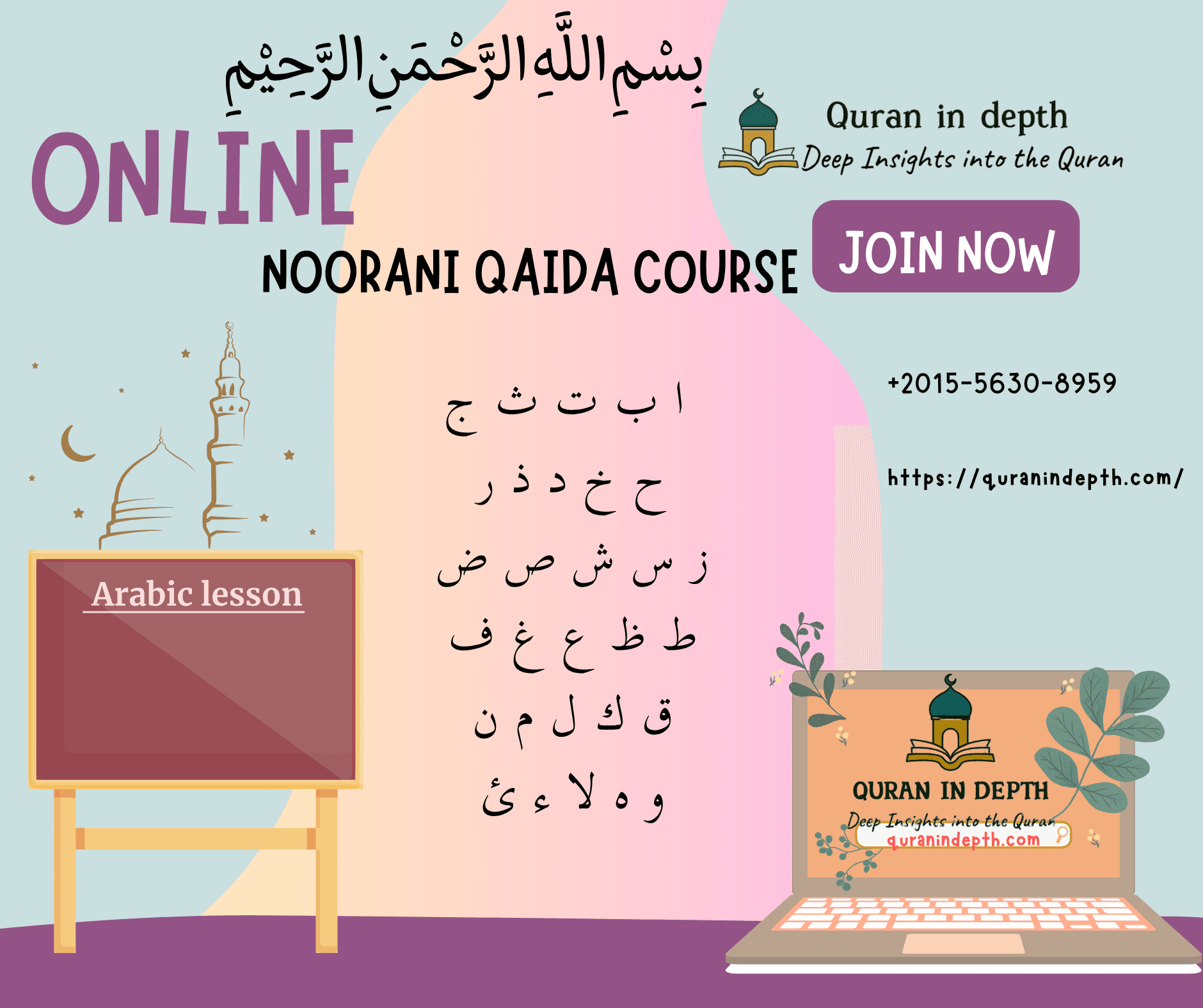
- Lessons 1–4: The 29 letters of the Arabic alphabet in isolated form. Each letter is learned with its name and its basic sound. Recognition from shape alone, before any vowels are added.
- Lessons 5–7: Letters in their connected forms — how each letter changes shape when it appears at the beginning, middle, or end of a word. This is often the most cognitively challenging section; letter recognition from chapter 1 must become automatic before connection forms are comfortable.
- Lessons 8–10: Short vowels (harakat) — the fatha, kasra, damma, and sukoon signs above and below letters. Reading simple consonant-vowel combinations like "ba," "bi," "bu," "baa," etc. until any vowel combination can be sounded instantly.
- Lessons 11–13: Long vowels (madd letters) — words where a short vowel is followed by a long vowel extension using ا، و، ي. Reading simple multi-syllable words.
- Lesson 14: Tanween — the doubled vowel markers that add an "n" sound at the end of words (فَتْحَتَان, كَسْرَتَان, ضَمَّتَان).
- Lesson 15: Shaddah — the gemination marker that doubles a consonant sound.
- Lessons 16–17: Combined reading exercises using all elements together — actual Quranic word patterns and short phrase constructions.
Upon completing all 17 lessons, the student should be able to read any vowelled Arabic text — including the fully vowelled text of the Quran — by sounding out each letter and vowel correctly.
How to use the Noorani Qaida with a teacher
Learning the Noorani Qaida with a teacher is strongly recommended, particularly for the letter articulation (makharij) work. A teacher serves two critical functions that no self-study method can replicate:
- Real-time pronunciation correction: The teacher hears whether your ع is coming from the throat (correct) or replacing it with a plain vowel (incorrect), whether your ق is genuinely uvular or mistakenly velar. These distinctions cannot be identified through self-study.
- Pacing guidance: The teacher decides when you are genuinely ready to move to the next lesson — not when you feel ready, which is usually earlier than you actually are. Moving on from a lesson before it is solid creates compounding difficulty in later lessons where earlier elements are assumed.
Typical pace with a teacher: 2–3 lessons per week, 20–30 minute sessions, completion of the full Qaida in 3–5 months for adults and 4–8 months for children. The timeline variation is large because individuals vary enormously in letter-recognition speed and phonetic acquisition.
How to use the Noorani Qaida independently (if a teacher is not yet available)
If you are starting independently before accessing a teacher — or supplementing teacher sessions with home practice — this approach produces the best results:
- Use the physical book and audio together: Download a free Noorani Qaida PDF and companion audio (widely available from Islamic educational sites). Follow the audio session while pointing to each letter or syllable in the physical text. This audio-visual pairing is significantly more effective than the text alone.
- Do not advance a lesson until you pass a self-test: Before moving to the next lesson, cover the current lesson page and test yourself: can you look away and produce each element from memory? Can you read any row on the page at roughly 1 syllable per second? If not, the lesson is not yet solid enough to advance.
- Spend extra time on the connection forms (lessons 5–7): This section is where most independent learners stall. The same letter in different positions looks different. Use flashcards with the three forms of each letter — beginning, middle, and end — until you can identify any form instantly regardless of context.
- Schedule teacher verification as soon as possible: Even one session with a qualified teacher to verify your letter sounds after completing lessons 1–4 prevents months of independent practice embedded with incorrect makharij.
Daily micro-lesson routines by schedule type
The most important factor in Noorani Qaida progress is consistency — five 15-minute sessions per week outperforms one 75-minute session every week by a significant margin for sound and letter recognition. Here are adapted daily practice models for different schedules:
For adults with busy schedules (15 minutes per day)
- Minutes 1–5 — Letter review: Open the current lesson. Read every row on the page at a moderate pace, focusing on producing each sound correctly rather than reading fast.
- Minutes 6–10 — Joining drill: If you are in lessons 5–7, focus exclusively on one letter's three forms. Write them out, then identify them in random positions on the current page.
- Minutes 11–15 — Previous lesson consolidation: Return to the lesson immediately before your current one and read it again. Consolidation of earlier material during current lesson study prevents the "leaky bucket" where you learn lesson 8 while lesson 5 fades.
For children ages 5–8 (10–12 minutes per day)
- Minutes 1–3 — Warm-up game: Parent randomly points to letters from a previous lesson; child names each one. Keep it playful and celebrate each correct answer.
- Minutes 4–8 — Current lesson work: Read the current lesson rows together — parent leads, child follows, then child leads alone. Focus on one specific letter or vowel type that was difficult last session.
- Minutes 9–10 — Reward and close: Child earns a sticker or mark on a progress chart. The visual accumulation of marks over weeks is a powerful motivator for this age group.
For beginners with a teacher (session preparation)
- Before each session: review the previous lesson once at reading speed. Note any specific row or letter type you stumbled on — bring this observation to your teacher.
- After each session: practise whatever the teacher assigned — typically a specific row or section — three times daily until the next session. Do not advance beyond the assignment independently; your teacher controls the pace for good reason.
The most challenging parts of the Noorani Qaida — and how to get through them
- The connected letter forms (lessons 5–7): The hardest cognitive leap in the Qaida. The same letter changes shape; the brain must learn to see "letter identity" rather than "visual shape." Solution: dedicated flashcard practice of the three forms of each letter independently before attempting to read connected text.
- Distinguishing visually similar letter pairs: ب/ت/ث, ح/خ/ج, ص/ض, ط/ظ, ع/غ are frequently confused. Solution: drill these pairs side-by-side until the distinction is immediate — not "I think that's a ح" but instant recognition without deliberation.
- Maintaining pace through later lessons: Motivation commonly dips around lessons 11–13, when the initial novelty has worn off but reading fluency is not yet satisfying. Solution: set a specific milestone goal — "by lesson 15, I will be able to read Al-Ikhlas from the Mushaf" — and return to that goal when motivation wavers.
FAQs about the Noorani Qaida
How long does it take to complete the Noorani Qaida?
With a qualified teacher and consistent daily practice of 15 minutes: 3–4 months for adults with good phonetic awareness, 4–6 months for adults who find new sounds challenging, 5–8 months for children aged 5–7. These timelines assume practice five or more days per week.
Do I need the physical book or can I use PDFs?
Both work. The physical book is preferred by many teachers because pointing to and tracking specific letters on a physical page reinforces spatial memory in a way that scrolling through a screen rarely does. Digital versions are convenient for travel and supplementary use and work well with audio companions.
After the Noorani Qaida, what comes next?
Direct Quran reading — typically starting with Juz Amma (the 30th juz, containing the shorter surahs most familiar from prayer). A teacher will then introduce basic Tajweed rules progressively as reading fluency develops. The Noorani Qaida completion is the gateway, not the destination.
Start your Noorani Qaida journey with structured teacher support: explore our dedicated Noorani Qaida course or book a free trial lesson for a placement assessment and your first session.